The Tsunami Risk Modeller’s Toolkit
Software and tools for tsunami risk analysis
The Tsunami Risk Modeller’s Toolkit (TRMTK) (DOI) is a library of Matlab and Python scripts and Jupyter notebooks to compute and visualize the empirical fragility and vulnerability assessment.
To contribute, you can establish your branch on ETRiS GitHub repository .
Jupyter Notebooks
VisualizeFragility
The Jupyter notebook “VisualizeFragility.ipynb” is used to visualize the fragility curves available on this service. To visualize the statistics of the fragility curves, it is necessary to specify the fragility curve corresponding to the desired damage level.
View on GitHub →VisualizeVulnerability
The Jupyter notebook “VisualizeVulnerability.ipynb” is used to visualize the vulnerability curves available on this service. To visualize the statistics of the vulnerability curves, it is necessary to specify the corresponding parameters or dataset as required.
View on GitHub →Bayesian Empirical Fragility Modeling
This Jupyter notebook presents the workflow for data-driven Bayesian empirical fragility modeling. It illustrates how the fragility data provided in the EPOS-ICS-C portal under the layer “Empirical Tsunami Risk Products Dataset (ETRiS v0)” can be generated.
View on GitHub →Direct Vulnerability Modeling (Binomial Regression)
This Jupyter notebook presents the workflow for vulnerability (fatality) modeling using Binomial Regression.
View on GitHub →Direct Vulnerability Modeling (Conditional CDF)
This Jupyter notebook presents the workflow for direct vulnerability (fatality) modeling, where the vulnerability is modeled as a conditional cumulative distribution function (CDF) of the loss ratio (decision variable) given the intensity measure.
View on GitHub →Vulnerability Modeling via Fragility–Consequence Convolution (Deterministic Consequence)
This Jupyter notebook describes how the vulnerability curves in the EPOS-ICS-C portal are calculated. It employs the convolution of empirical fragility, derived from the Bayesian Empirical Fragility Modeling notebook, with a deterministic consequence function.
View on GitHub →Vulnerability Modeling via Fragility–Consequence Convolution (Probabilistic Consequence)
This Jupyter notebook describes how the vulnerability curves in the EPOS-ICS-C portal are calculated. It employs the convolution of empirical fragility, derived from the Bayesian Empirical Fragility Modeling notebook, with an uncertain consequence function.
View on GitHub →ComputeFrag
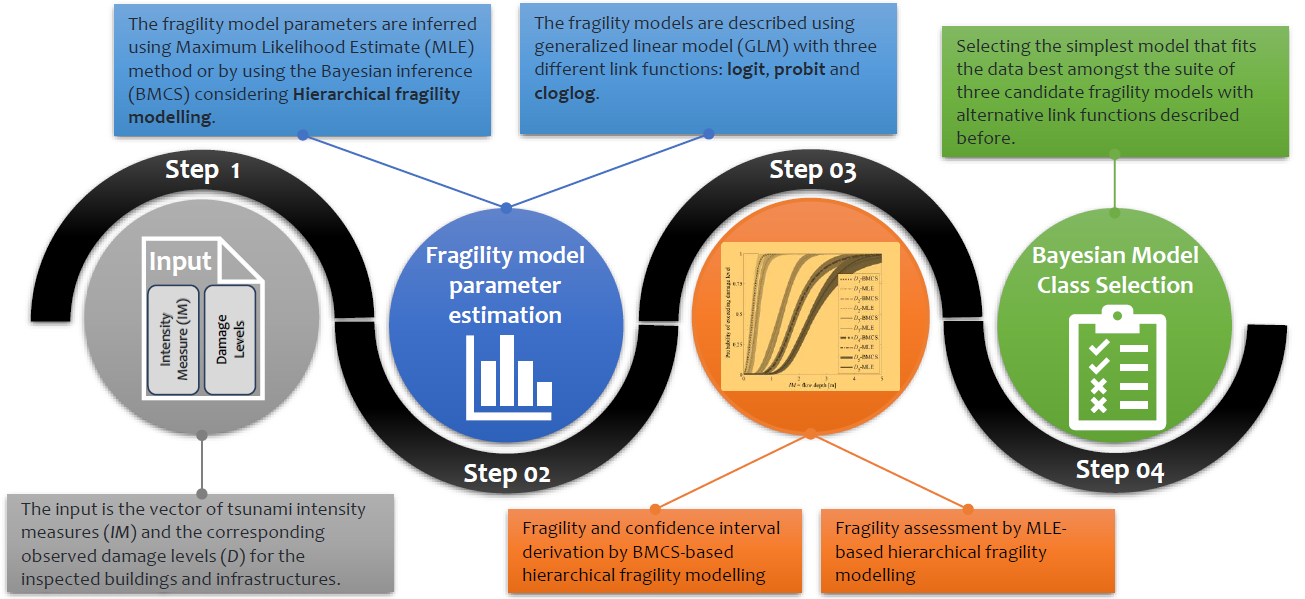
ComputeFrag is a code for computing robust fragility curves using a generalized regression model considering Hierarchical fragility modeling.
This code calculates fragility curves based on maximum likelihood estimation methods (basic and hierarchical modeling) or using Bayesian model class selection (BMCS) to estimate fragility curves with their corresponding confidence bands for a set of mutually exclusive and collectively exhaustive damage states and different classes of buildings or infrastructure.
The code utilizes Bayesian model class selection (BMCS) to identify the best link model to employ in the generalized linear regression scheme.
More information about the code: README.md
ComputeFrag workflow
Docker
You can also check our Docker repository
- Install Docker Desktop from Docker repository .
- Pull the image from Docker Hub using the following command:
- Create a new folder to save the results (e.g. C:\computefragresults\ on Windows or /home/user/computefragresults on Linux).
- Place the input file, for example buildingclass1.csv , in that folder.
- Execute the application using one of the following commands, depending on your operating system.